Graeme Clark Biography: Inspiring Bionic Ear Pioneer
Discover his childhood, education, cochlear implant breakthrough, family life, awards and lasting impact on hearing science

Introduction
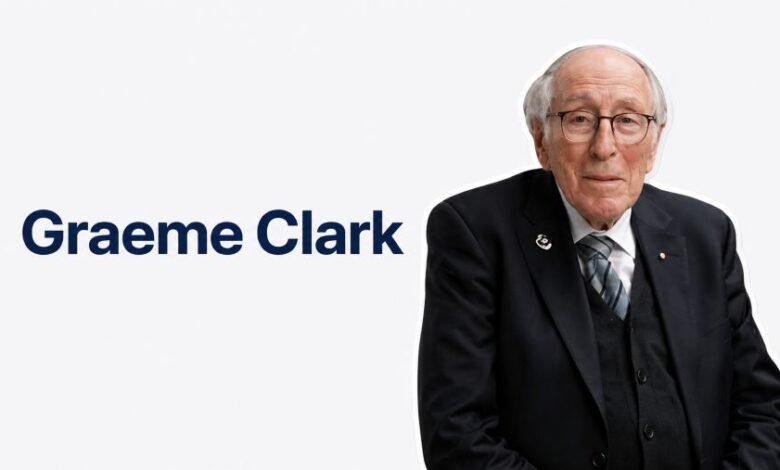
Graeme Clark is an Australian professor, ear surgeon, medical researcher and inventor. He is best known for leading the team that developed Australia’s successful multi-channel cochlear implant, commonly called the bionic ear.
His work brought medicine, electronics, speech science and engineering together. It helped create a device that allows many people with severe or profound hearing loss to receive useful sound and understand spoken language.
Professor Clark’s story is not only about an invention. It is also about persistence, careful testing and the belief that science should improve human life.
Graeme Clark Quick Bio
| Field | Verified Information |
|---|---|
| Full Name | Graeme Milbourne Clark |
| Professional Name | Professor Graeme Clark |
| Date of Birth | 16 August 1935 |
| Age | 90 years old, as of June 2026 |
| Birthplace | Camden, New South Wales, Australia |
| Nationality | Australian |
| Gender | Male |
| Profession | Otolaryngologist, surgeon, professor, researcher and inventor |
| Famous For | Leading the development of the multi-channel cochlear implant |
| Main Fields | Otolaryngology, auditory neuroscience and medical bionics |
| School | The Scots College, Sydney |
| University | University of Sydney |
| Qualifications | MBBS with honours, Master of Surgery and PhD |
| Spouse | Margaret Clark |
| Academic Position | Honorary Laureate Professor Emeritus, University of Melbourne |
| Major Honour | Companion of the Order of Australia |
| Latest Major Award | 2026 Queen Elizabeth Prize for Engineering |
Who Is Graeme Clark?
Graeme Milbourne Clark is a respected Australian surgeon-scientist whose research transformed the treatment of profound hearing loss.
He specialised in otolaryngology, the area of medicine concerned with the ears, nose and throat. However, his career went far beyond normal clinical practice.
Professor Clark studied how electrical signals could communicate sound information directly to the auditory nerve. His research eventually led to a multi-channel system capable of carrying important speech information.
Like experts working in modern neuroscience research, he needed to understand both the physical structure of the nervous system and the way the brain interprets complex signals.
His achievement helped establish medical bionics as an important research field and created new possibilities for restoring human senses through technology.
Early Life and Childhood
Graeme Clark was born on 16 August 1935 in Camden, New South Wales, Australia.
His father worked as a pharmacist and experienced serious hearing loss. Clark watched him struggle to understand customers and take part in conversations.
This personal experience gave him an early reason to study hearing. As a young child, he reportedly expressed a desire to “fix ears” because he understood how deafness affected his father.
His mother encouraged his interest in art and music, while his father supported his practical interest in medicine and science.
Clark enjoyed reading, Scouts, sport and simple experiments. He later recalled conducting biological experiments in his mother’s laundry and his father’s pharmacy.
Reading about scientists such as Louis Pasteur also strengthened his belief that carefully designed experiments could solve medical problems.
A detailed Australian Academy of Science interview records many of these childhood experiences and explains how his father’s deafness shaped his future career.
School and University Education
Clark attended The Scots College in Sydney as a boarding student. He completed his secondary education in 1951.
Boarding school was initially challenging because he was shy and away from his family. However, the experience helped him develop independence and discipline.
He later entered the University of Sydney to study medicine. He was still a teenager when he began his university education.
Clark completed his medical degree with honours in 1957. He also ranked first in his final medical examinations.
His strong performance showed an early ability to understand physiology, anatomy and the scientific principles behind medical treatment.
After gaining professional experience, he returned to university for advanced study. He completed a Master of Surgery in 1968 and a PhD in 1969.
His doctoral research examined hearing mechanisms, electrical stimulation and the way sound information reaches the brain.
Medical and Surgical Training
After completing his medical degree, Clark worked as a resident medical officer at Royal Prince Alfred Hospital and North Shore Hospital.
He received training in general surgery, neurosurgery and otolaryngology. This wide experience helped him understand the delicate relationship between the ear, nerves and brain.
In 1962, he travelled to England and worked at the Royal National Throat, Nose and Ear Hospital in London.
He later became a senior registrar in otolaryngology at Bristol General Hospital before returning to Australia in 1963.
After returning, he worked at the Royal Victorian Eye and Ear Hospital. He also held surgical roles at other major hospitals in Melbourne.
His clinical career gave him direct experience with people whose hearing could not be restored through the treatments available at the time.
Why He Chose Medical Research
Clark could have continued building a financially secure career as a surgeon. Instead, he reduced his clinical work and returned to academic research.
This decision placed financial pressure on his young family. It also exposed him to criticism from scientists who believed his cochlear implant idea would fail.
One senior researcher reportedly suggested that Clark was already too old to begin a serious research career while he was still in his early thirties.
Clark continued because he believed existing single-channel devices could not carry enough information for a person to understand speech.
He proposed using several electrodes to stimulate different locations inside the cochlea. Each location could represent a different range of sound frequencies.
This approach required the same patience and careful validation seen in wider biomedical research, where an idea must pass laboratory, safety and clinical tests before it can help patients.
Academic Career at the University of Melbourne
In 1969, Clark accepted the William Gibson Chair of Otolaryngology at the University of Melbourne.
He began working as the foundation professor of otolaryngology in 1970. The position allowed him to build a team around his cochlear implant research.
His team included surgeons, engineers, audiologists, physiologists, speech scientists and technical specialists.
This multidisciplinary structure was essential because no single profession could solve every part of the problem.
Clark needed specialists who understood surgery, electrical circuits, sound coding, human speech, nerve stimulation and patient rehabilitation.
His approach reflected the value of collaboration among university professors and researchers working on difficult scientific questions.
The Cochlear Implant Breakthrough
One of Clark’s biggest challenges was designing an electrode bundle that could travel around the spiral-shaped cochlea without causing serious damage.
An important idea reportedly came while he was at Minnamurra Beach. He experimented with flexible grass blades and a spiral shell.
He observed that a blade with a soft tip and a firmer base could move around the spiral more safely.
This simple observation helped guide the design of a flexible electrode array that could be inserted into the cochlea.
On 1 August 1978, Clark and surgeon Brian Pyman implanted an experimental multi-channel device in Rod Saunders, an adult who had profound hearing loss.
The operation was only the beginning. The team then needed to test whether the electrical signals could provide meaningful sound information.
Later testing showed that stimulation at different positions could communicate different frequency information.
Saunders was able to identify important speech sounds through the device. This result proved that the multi-channel approach could offer useful speech understanding.
How the Bionic Ear Works
A cochlear implant does not work like a normal hearing aid.
A hearing aid mainly makes sound louder. A cochlear implant converts sound into electrical signals that stimulate the auditory nerve.
An external microphone receives sound from the environment. A sound processor analyses that sound and converts it into coded information.
The implant then sends electrical signals to electrodes placed inside the cochlea. Different electrodes represent different sound frequencies.
The auditory nerve carries this information to the brain, where the signals are interpreted as sound.
Understanding this process required research into hearing, speech and brain science, as well as major advances in engineering and surgical safety.
Results can differ between users, and rehabilitation remains an important part of learning to understand sound through the implant.
Commercial Development and Cochlear Limited
After the early success, the University of Melbourne team worked with Nucleus Limited to develop a reliable commercial device.
The partnership helped transform an experimental university system into technology that could be produced and used in hospitals.
The device received approval in the United States for adults in 1985. Approval for children aged two and older followed in 1990.
Clark also helped establish a public cochlear implant clinic at the Royal Victorian Eye and Ear Hospital.
The clinic brought surgery, testing, speech support and rehabilitation together in one organised program.
The research later supported the growth of Cochlear Limited. However, the company should not be described as a business personally owned by Professor Clark.
His main role was scientific, surgical and academic. Commercial partners handled large-scale manufacturing, product development and international distribution.
Important Team Members and Collaborators
Professor Clark has always described the implant as a team achievement.
Brian Pyman played an important role in surgery, while David Dewhurst contributed electrical engineering knowledge.
Joe Tong worked on psychophysics and speech research. Jim Patrick and Peter Seligman made major engineering and sound-processing contributions.
Robert Webb also contributed surgical expertise, particularly during the development of implants designed for children.
The early implant recipients were equally important. They accepted the risks of experimental treatment and helped researchers understand what the electrical signals sounded like.
Clark’s public recognition of his colleagues has strengthened his reputation as a collaborative scientific leader.
Marriage, Family and Faith
Graeme Clark is married to Margaret Clark.
He has credited Margaret with supporting him through financial pressure, scientific criticism and the demanding years of cochlear implant development.
Clark has also referred publicly to raising a family while completing his research. He has generally kept the private lives of his children outside public attention.
His Christian faith has been openly discussed in interviews and writings. He has said that prayer and a desire to help other people supported him during difficult periods.
His publicly stated values include compassion, teamwork, patient safety and the responsible use of science.
He believed that professional success alone was not enough. Research needed to produce a real improvement in people’s lives.
Public Image and Work Ethic
Professor Clark is widely associated with persistence, curiosity and careful scientific practice.
He continued his research despite limited funding and widespread doubt about whether electrical stimulation could communicate speech.
He did not respond to safety concerns by ignoring them. His team conducted anatomical studies, biological testing and controlled clinical work before expanding the treatment.
His career also connects with research into neuroscience and human behaviour, where researchers must carefully explain how biological processes influence real human experiences.
Clark regularly shared credit with his wider team, institutions and implant recipients.
This combination of persistence and humility became an important part of his public image.
Major Books and Publications
Professor Clark has written scientific papers, technical studies and books about hearing technology.
His 2000 book, Sounds from Silence, tells the personal story of the bionic ear’s development.
He later wrote Cochlear Implants: Fundamentals and Applications. The book examines cochlear biology, surgery, electrode systems, speech processing and clinical treatment.
In 2021, he published I Want to Fix Ears: Inside the Cochlear Implant Story.
The title reflects the ambition he expressed as a young child after seeing the effect of hearing loss on his father.
His written work documents the scientific problems, financial struggles, ethical questions and professional partnerships involved in creating the implant.
Awards and Honours
Professor Clark has received many Australian and international honours.
He was appointed an Officer of the Order of Australia in 1983.
He became Senior Australian of the Year in 2001 and was appointed a Companion of the Order of Australia in 2004.
That same year, he received the Prime Minister’s Prize for Science and was elected a Fellow of the Royal Society.
His other major honours include the Lister Medal, the CSL Florey Medal and the Lasker–DeBakey Clinical Medical Research Award.
These awards recognised both the scientific importance of his work and its practical effect on people with hearing loss.
Current Status and 2026 Recognition
As of June 2026, Professor Clark is 90 years old.
He holds the title of Honorary Laureate Professor Emeritus in the Department of Surgery at the University of Melbourne.
In February 2026, he received the Queen Elizabeth Prize for Engineering alongside other pioneers of modern neural-interface technology.
The official University of Melbourne announcement recognised his contribution to multi-channel stimulation, cochlear implants and technologies that restore human functions.
The award came more than four decades after the first experimental implantation, showing the lasting importance of his work.
Charity Work and the Graeme Clark Foundation
The Graeme Clark Foundation supports medical research, education and assistance for people affected by sensory or neurological conditions.
Its work has included support for hearing programs, audiology education and research into medical bionics.
Projects connected with the foundation have also supported disadvantaged children and communities needing better access to hearing care.
Clark has donated prize money to support younger researchers and biomedical-engineering projects.
This work reflects the same goal that guided his original research: using knowledge and technology to give people greater opportunities.
Legacy and Global Impact
Graeme Clark’s most important legacy is the successful translation of a scientific idea into a practical medical treatment.
Modern cochlear implants have restored access to useful sound for more than one million people worldwide.
The technology has helped many adults communicate after losing their hearing. It has also given children born with severe hearing loss another pathway towards spoken-language development.
The field continues to develop through improved processors, smaller components, better electrodes and more personalised rehabilitation.
Clark’s work also influenced research into bionic eyes, spinal-cord systems, brain stimulation and other neural interfaces.
The Graeme Clark Institute for Biomedical Engineering and other programs carrying his name continue to support research connecting medicine with engineering.
Interesting Facts About Graeme Clark
- His father’s hearing loss inspired his interest in ear medicine.
- He entered medical school while still a teenager.
- He ranked first in his final medical examinations.
- He conducted simple scientific experiments during childhood.
- Grass blades and a spiral shell helped inspire the cochlear electrode design.
- He left a secure surgical career to pursue uncertain research.
- The first experimental multi-channel implantation took place in 1978.
- He founded the Bionic Ear Institute.
- He has written technical books and personal accounts of his work.
- He celebrated his 90th birthday in August 2025.
- He received the Queen Elizabeth Prize for Engineering in 2026.
Conclusion
Graeme Clark’s life shows how personal experience can inspire a major scientific achievement.
His father’s hearing loss gave him an early purpose, but turning that purpose into working technology required decades of education, testing and collaboration.
The multi-channel cochlear implant became one of Australia’s most important medical innovations. It changed hearing care while helping establish the wider field of medical bionics.
Professor Clark’s legacy belongs not only to engineering or surgery. It can also be seen in the lives of people who gained greater access to sound, speech and communication through the work of his team.
Frequently Asked Questions
Who is Graeme Clark?
He is an Australian professor, surgeon and medical researcher known for pioneering the multi-channel cochlear implant.
What is Graeme Clark’s full name?
His full name is Graeme Milbourne Clark.
When was he born?
He was born on 16 August 1935.
How old is he?
He is 90 years old as of June 2026.
Where was he born?
He was born in Camden, New South Wales, Australia.
What did he study?
He studied medicine, surgery, hearing science and auditory-neural stimulation.
Who is his wife?
He is married to Margaret Clark.
What is his most famous invention?
He is famous for leading the development of Australia’s multi-channel cochlear implant.
Is Graeme Clark still alive?
Yes. He remains an Honorary Laureate Professor Emeritus at the University of Melbourne.
What award did he receive in 2026?
He received the Queen Elizabeth Prize for Engineering for his contribution to modern neural interfaces.